
Whole Grains vs. Refined Grains: Why the Difference Matters
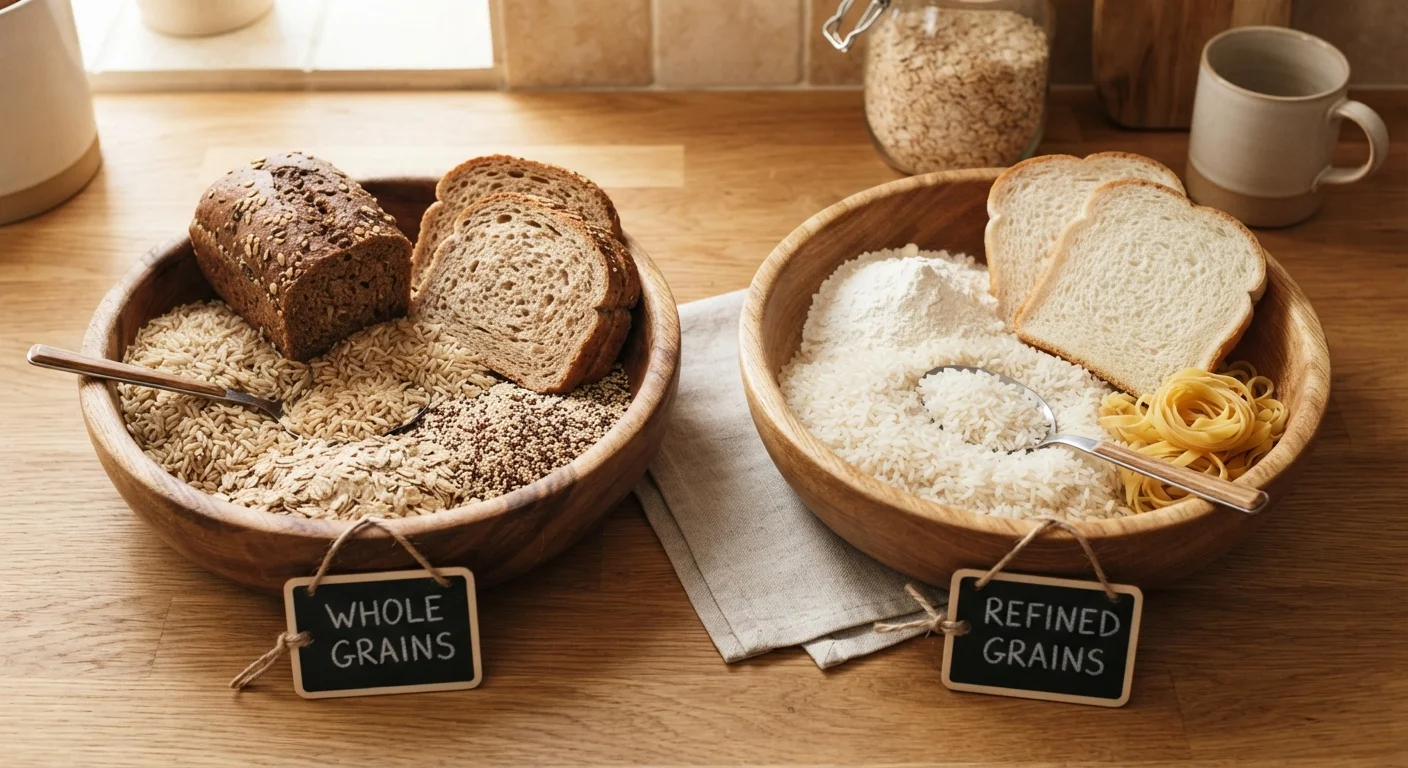
Photo credit: InfoHorizon.net | Access To Informative Content
In this article
Learn what sets whole grains apart from refined ones, how processing changes nutritional value, and which foods fall into each category.
Key Takeaways
- Whole grains retain all three parts of the kernel: bran, germ, and endosperm.
- Refining removes the bran and germ, stripping away fiber, vitamins, and minerals.
- Many refined grain products are enriched, but enrichment restores only select nutrients.
- Switching even some refined grains for whole grains can meaningfully improve dietary fiber intake.
- Food labels can help you spot the difference — look for 'whole grain' as the first ingredient.
What Makes a Grain 'Whole'
Every grain kernel is made up of three distinct layers, each serving a different nutritional purpose. The bran is the fibrous outer shell, packed with B vitamins, iron, and dietary fiber. The germ is the nutrient-dense core, rich in healthy fats, vitamin E, and additional B vitamins. The endosperm is the starchy middle layer that feeds the sprouting seed and makes up the bulk of the kernel.
A grain is considered whole when all three parts remain intact after processing — whether the grain is ground into flour, rolled into flakes, or cooked and eaten as-is. Common whole grains include oats, brown rice, whole wheat, quinoa, barley, farro, and popcorn. When you eat these, you're getting everything the kernel has to offer.
This is meaningfully different from how most grain-based foods are made in the modern food supply, which brings us to what refining actually does. For a broader look at how processing affects food quality, see how whole and processed foods compare.
How Refining Changes the Grain
Refining is a milling process that removes the bran and germ, leaving only the starchy endosperm. The result is a smoother, lighter product with a longer shelf life — qualities that made refined grains commercially attractive. White flour and white rice are the most familiar examples.
The trade-off is nutritional. When the bran and germ are stripped away, so are most of the fiber, B vitamins (thiamine, riboflavin, niacin, folate), iron, and beneficial plant compounds. What's left is primarily starch.
| Criterion | Whole Grains | Refined Grains |
|---|---|---|
| Kernel parts retained | Bran, germ, and endosperm | Endosperm only |
| Dietary fiber | High | Low |
| B vitamins (natural) | Naturally present | Mostly removed; some added back |
| Iron | Naturally present | Mostly removed; some added back |
| Shelf life | Shorter (fats in germ can go rancid) | Longer |
| Texture in baking | Denser, heartier | Lighter, airier |
| Common examples | Oats, brown rice, whole wheat | White rice, white flour, white bread |
To counter the nutrient loss, many refined grain products in the U.S. are enriched — meaning that certain B vitamins and iron are added back after milling. Enrichment is required by law for many grain products sold in the U.S. However, enrichment does not restore fiber, and it replaces only a handful of the nutrients that were originally present. Whole grains still come out ahead nutritionally.
What 'Enriched' Actually Means
Enriched grain products have had specific nutrients added back after milling — typically thiamine, riboflavin, niacin, folic acid, and iron. This process was introduced to address nutrient deficiencies in the population, and it has been effective for certain concerns like reducing folate deficiency. That said, enrichment is not the same as restoration. Fiber, magnesium, zinc, and dozens of plant compounds present in the whole grain are not replaced by enrichment.
Spotting Whole Grains on a Label
Food packaging can be misleading. Terms like "multigrain," "seven-grain," "stone-ground," or "wheat bread" do not automatically mean whole grain. A product labeled "multigrain" simply contains more than one type of grain — those grains can all be refined.
The reliable signal is the ingredient list. Look for the word "whole" before the grain name as the first ingredient — for example, "whole wheat flour" or "whole oat flour." If "enriched wheat flour" appears first, the product is primarily refined.
The nutrition facts panel is another useful tool. A meaningful amount of dietary fiber per serving is a good indicator of whole grain content, since fiber is largely removed during refining. Our guide to reading a nutrition label walks through exactly how to interpret those numbers with confidence.
25%
Average American fiber intake vs. recommended amount
Most Americans consume only about 25% of the recommended daily fiber intake, according to data from the U.S. Dietary Guidelines Advisory Committee.
3x
More fiber in whole wheat vs. white flour
Whole wheat flour contains roughly three times the dietary fiber of refined all-purpose white flour per equivalent serving.
Making the Shift in a Real Kitchen
Swapping refined grains for whole grains doesn't have to be all-or-nothing. Small, consistent changes make a real difference over time. Start by replacing one refined grain with a whole grain equivalent at each meal — brown rice instead of white, whole wheat pasta instead of regular, oats instead of a refined cereal.
If the texture of whole grain baked goods is a barrier, try blending whole wheat flour with all-purpose flour in a roughly 50/50 ratio. This lightens the crumb while still boosting fiber and nutrients. Whole grain options also vary widely in flavor and texture — farro has a pleasant chewiness, barley is mild and hearty, and quinoa cooks quickly and works in both savory and sweet dishes.
The goal isn't perfection. Even dietary guidance from major nutrition organizations frames it as making half your grains whole — a realistic, achievable target for most people eating a varied diet. If you're curious how grain choices fit into a larger dietary pattern, comparing plant-based and omnivorous diets offers helpful perspective on where grains fit in overall.
This article is for general informational purposes only and is not a substitute for personalized nutrition or medical advice. Consult a registered dietitian or qualified healthcare provider for guidance specific to your health needs.

Author
Food Editorial Team
Food Editorial Team is the collective byline for our editorial team and contributor network. Articles published under this byline or an editorial pen name are researched, written, and reviewed according to our editorial standards for clarity, consistency, and independence before publication.
View all articles →