
Tea Across Cultures: How the Same Leaf Became a Thousand Different Drinks
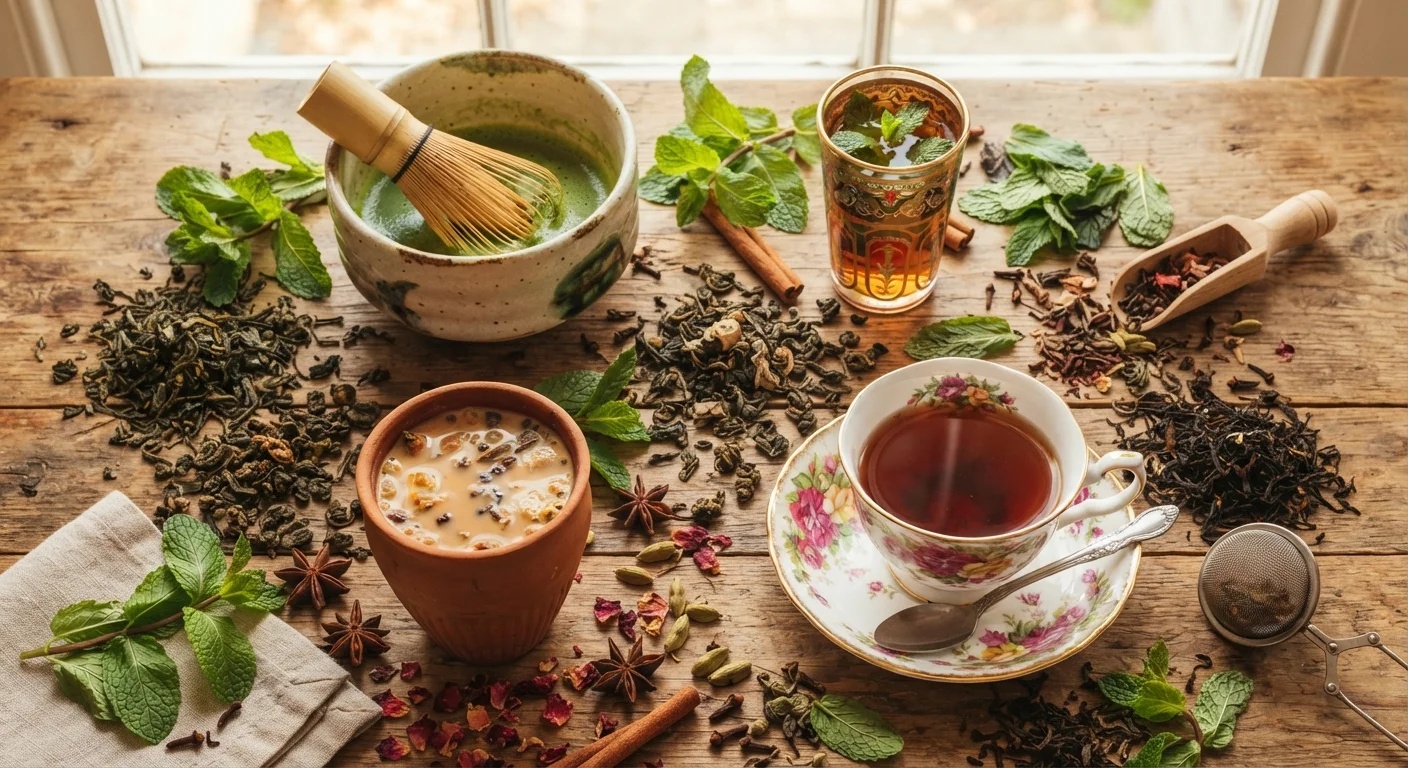
Photo credit: InfoHorizon.net | Access To Informative Content
In this article
From Japanese matcha ceremonies to Moroccan mint tea rituals, explore how different cultures transformed the tea leaf into distinct traditions.
Key Takeaways
- All true tea — green, black, white, oolong — comes from the same plant species, Camellia sinensis.
- Processing techniques like oxidation and steaming create the dramatic flavor differences between tea types.
- Tea rituals worldwide reflect local values: mindfulness in Japan, hospitality in Morocco, community in India.
- Climate, trade history, and colonialism all shaped which tea styles took root in which regions.
- Adding milk, spices, mint, or butter transforms tea's flavor profile in ways unique to each culture.
One Plant, Radical Diversity
It seems almost impossible that the frothy, grassy bowl of matcha served in a Japanese tea house and the milky, cardamom-spiked chai poured at an Indian street stall share the same origin. Yet both begin with the dried leaves of Camellia sinensis, a shrub native to the mountainous regions of southwest China and northern Myanmar.
What separates these drinks isn't the plant — it's everything done to the leaf afterward. Oxidation, steaming, rolling, shading, fermenting, grinding: each technique alters the leaf's chemical makeup, color, and flavor in fundamental ways. Then culture steps in, layering on centuries of ritual, preference, and meaning. The result is a beverage that reads as entirely different depending on where in the world you're drinking it.
Understanding tea through a cultural lens also illuminates something useful: flavor isn't fixed. It's shaped by method, context, and intention — principles that apply well beyond tea. If you're interested in how preparation transforms flavor across beverages, see our guide to drink pairing principles.
~6 billion
Cups of tea consumed worldwide daily
Tea is the second most consumed beverage on Earth after water, according to widely cited estimates from international food and agriculture organizations.
5,000+
Years of tea cultivation history
Historical records and archaeological evidence suggest tea consumption in China dates back at least to the Han Dynasty, with legends placing its origins even earlier.
Over 50
Countries producing commercial tea
The UN Food and Agriculture Organization tracks tea production in more than 50 countries, with China, India, Kenya, and Sri Lanka leading global output.
East Asia: Craft, Ceremony, and Green Tea
China is where tea cultivation began, and the range of tea styles developed there over centuries remains unmatched. Chinese tea culture prizes variety and nuance — green teas like Longjing, white teas like Bai Hao Yinzhen, lightly oxidized oolongs, and aged pu-erh are all distinct products of different regions and techniques, often consumed in a contemplative, sequential style known as gongfu cha (literally, tea with skill).
Japan adopted tea from China around the 8th century but developed it along its own path. The Japanese chado (way of tea) centers on powdered matcha, prepared with a bamboo whisk in a ceramic bowl. The practice is deeply influenced by Zen Buddhist philosophy — every movement in the ceremony is deliberate, and the tea bowl is turned in the hands before drinking as an act of respect.
“Tea is a religion of the art of life. It is a cult founded on the adoration of the beautiful among the sordid facts of everyday existence.”
— Kakuzo Okakura, Japanese scholar and author of 'The Book of Tea' (1906)
In both traditions, the focus is on the tea itself — no milk, no sweetener, nothing that might obscure what the leaf offers. Water temperature, steeping time, and vessel selection are treated as serious variables, not afterthoughts.
South Asia and the Middle East: Tea as Hospitality
When the British established large-scale tea plantations in Assam and Darjeeling in the 19th century, they transformed India into one of the world's largest tea producers. But Indian culture took the British model and made it something entirely its own. Masala chai — black tea simmered directly with milk, water, sugar, and a blend of warming spices like ginger, cardamom, cinnamon, and clove — bears little resemblance to anything produced in a London drawing room. It's bold, sweet, spiced, and served in small cups at nearly every hour of the day.
In Morocco, tea is equally central to social life. Atay — gunpowder green tea brewed with fresh spearmint and plenty of sugar — is poured from a considerable height to create a frothy top, a gesture of welcome as much as technique. Refusing a cup is considered impolite; accepting it is an acknowledgment of the host's generosity.
The shared thread across South Asian and Middle Eastern traditions is that tea signals hospitality. Preparing and serving tea for a guest is an act of care, not just refreshment.
Western Adaptations and New Traditions
Britain's relationship with tea was built almost entirely on black tea — strong, often with milk and sugar — a preference shaped by trade with India and Sri Lanka rather than China's more delicate styles. The ritual of afternoon tea, formalized in the 19th century, became a social institution. Today, tea bags and electric kettles have simplified the preparation, but the cultural habit remains.
In the United States, tea followed a different trajectory. The country's dominant tea culture skews iced: sweet tea, a staple of the American South, is brewed strong, heavily sweetened while hot, and poured over ice. Elsewhere in the U.S., tea consumption has grown more diverse, with loose-leaf green teas, oolong, and herbal blends gaining ground alongside the traditional iced format. Just as seasonal and cultural context shapes beverage preference in general — a point explored in our article on seasonal drinking — tea choices in the U.S. increasingly reflect the time of year and occasion.
Experimenting with Tea Styles at Home
If you want to explore different cultural tea traditions, start by adjusting your brewing method rather than buying specialty equipment. Try steeping green tea at a lower water temperature (around 160–175°F) to reduce bitterness, or simmer black tea directly with milk and a cardamom pod to approximate a simple masala chai. Small changes in water temperature, steep time, and additions reveal how much technique shapes the final cup.
Tea is also entering new cultural territory through fermentation. Kombucha, a fermented tea beverage popular across the globe, represents another chapter in tea's story — one explored in our piece on fermented drinks beyond beer and wine.
Frequently Asked Questions

Author
Food Editorial Team
Food Editorial Team is the collective byline for our editorial team and contributor network. Articles published under this byline or an editorial pen name are researched, written, and reviewed according to our editorial standards for clarity, consistency, and independence before publication.
View all articles →