
Envelope Budgeting vs. Digital Tracking Apps
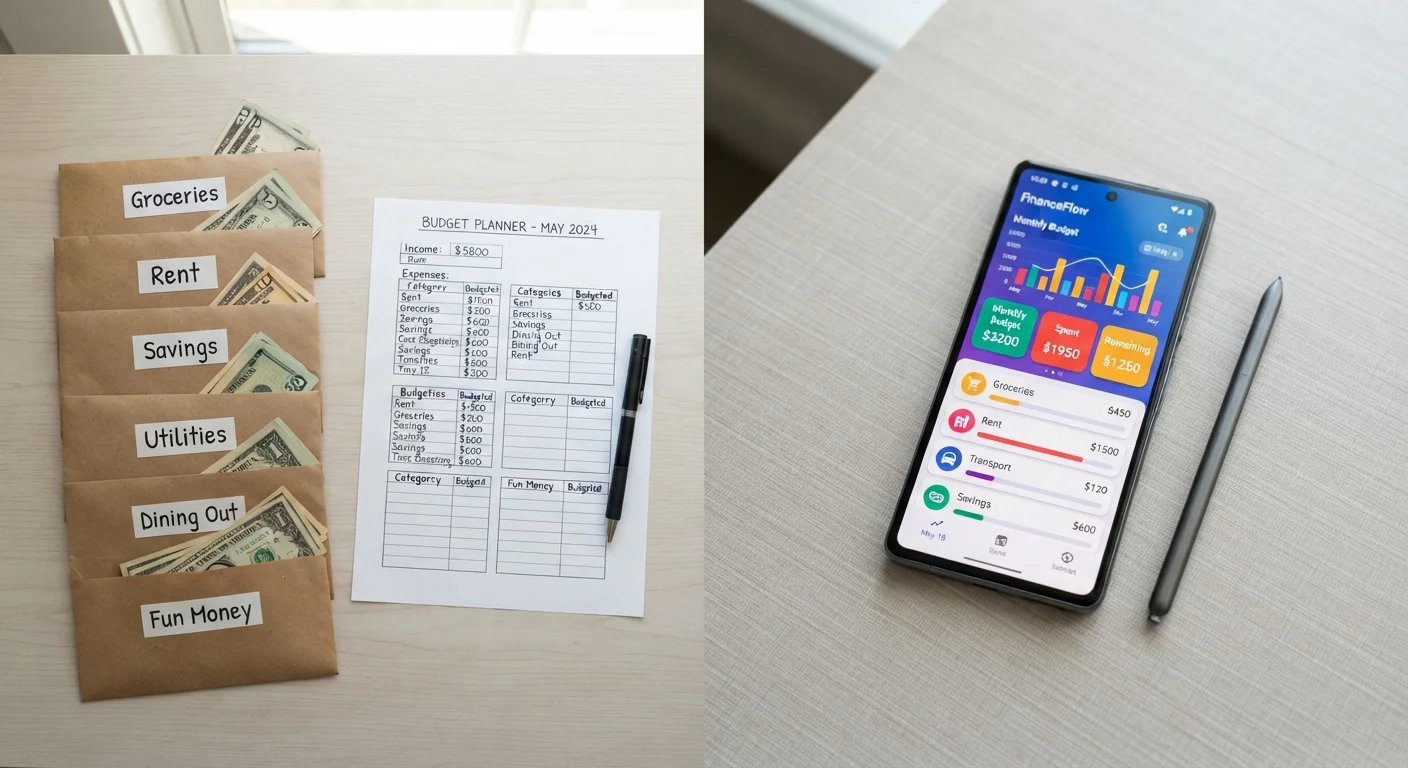
Photo credit: InfoHorizon.net | Access To Informative Content
In this article
Cash envelopes and budgeting apps each have real strengths and real tradeoffs. See how they compare so you can pick the method that fits your habits.
Key Takeaways
- Envelope budgeting uses physical cash to create hard spending limits that are difficult to ignore.
- Digital tracking apps automate transaction logging and provide real-time spending visibility.
- Your best method depends on your spending habits, discipline style, and comfort with technology.
- Hybrid approaches — using both methods for different spending categories — are a valid option.
- Neither method works without a baseline budget plan to support it.
How Each Method Works
Envelope budgeting is straightforward: at the start of each pay period, you withdraw cash and divide it into labeled envelopes — one for groceries, one for dining out, one for gas, and so on. When an envelope is empty, spending in that category stops. The system originated before digital banking and remains popular precisely because its limits are physical and undeniable.
Digital tracking apps work differently. Instead of pre-allocating cash, they link to your bank accounts and cards, automatically categorizing transactions as they happen. Many apps also let you set category budgets and send alerts when you're approaching a limit. The feedback is real-time, but it arrives after the transaction — not before it.
If you're new to either approach, it helps to first build a solid income-and-expense baseline. See our beginner's guide to personal budgeting for the foundational steps before choosing a tracking method.
Comparing the Two Approaches
The table below breaks down how envelope budgeting and digital tracking apps stack up across the criteria that matter most for everyday use.
| Criterion | Envelope Budgeting | Digital Tracking App | |
|---|---|---|---|
| Setup effort | Low — cash and envelopes only | Moderate — account linking and configuration | |
| Ongoing maintenance | Manual; requires cash handling each pay period | Mostly automated after initial setup | |
| Spending friction | High — limits are physical and immediate | Low — tracks after spending occurs | |
| Visibility across accounts | Limited to cash categories only | Broad — covers all linked accounts | |
| Privacy and data sharing | None — fully offline | Requires linking financial accounts to a third party | |
| Best for | Targeted overspending control | Holistic financial monitoring | |
| Works with digital payments | Not directly | Yes — designed for card and bank transactions | |
| Cost | Free | Free to paid tiers depending on app |
For a broader look at how these methods fit within larger budgeting frameworks, the spending tracker comparison covers paper, spreadsheet, and app-based options side by side.
Where Envelope Budgeting Has the Edge
The psychological advantage of cash is well-documented in consumer behavior research: people tend to spend less when they hand over physical bills versus tapping a card. For categories where overspending is a recurring problem — restaurants, clothing, entertainment — an envelope creates a hard stop that a push notification simply cannot replicate.
Envelope budgeting also requires no technology, no subscription, and no account linking. For people who are skeptical of sharing financial data with third-party apps, or who simply prefer low-tech solutions, it removes friction in a different direction.
Start with Your Problem Categories
You don't have to run your entire budget through cash envelopes to benefit from the method. Identify the one or two spending categories where you consistently overspend and apply the envelope system only there. This focused approach reduces the logistical burden while still delivering the psychological benefit of a hard limit.
The main drawback is practicality. Most bills are paid digitally, many stores discourage large cash transactions, and carrying envelopes everywhere isn't realistic for everyone. Envelope budgeting works best when applied selectively to the two or three categories where overspending actually happens, rather than to every dollar you spend.
Where Digital Tracking Apps Have the Edge
Apps shine when your financial life is spread across multiple accounts, credit cards, and automatic payments. Manual cash accounting can't easily capture a subscription charge, a mortgage auto-draft, and a grocery run in one view — but an app can. That consolidated visibility is genuinely useful for spotting patterns over time.
Automation also lowers the daily effort required. Once accounts are linked and categories are configured, the app does the logging for you. This is a meaningful advantage for people who know they won't maintain a manual system long-term.
App Alerts Are Not the Same as Limits
A budgeting app that notifies you when you've hit 80% of your grocery budget still lets you keep spending — it just tells you about it. If you find that notifications don't change your behavior in the moment, the app's alert system alone won't solve an overspending pattern. Consider pairing app tracking with a deliberate review routine, or adding envelope budgeting for high-risk categories.
Apps also make it easier to run a monthly review. Pairing an app with a structured audit process — like the one outlined in our monthly budget audit checklist — helps you catch spending drift before it compounds. Whichever method you use, a regular review habit matters more than the tool itself.
Choosing What Will Actually Work for You
The honest answer is that the right method is the one you'll use consistently. A perfect system that you abandon after three weeks accomplishes less than a good-enough system maintained for three years.
Consider your specific friction points. If you repeatedly overspend on discretionary categories, envelope budgeting for those specific areas can create real change. If your challenge is losing track of subscriptions and fixed costs, an app's automation is more valuable. Many people run a hybrid: cash envelopes for two or three problem categories and an app for everything else.
Both methods also work alongside larger frameworks. The 50/30/20 and zero-based budgeting comparison can help you decide how to allocate your money before you pick a tool to track it. And if you're building or strengthening a monthly plan, our guide to setting up a monthly budget walks through each step in practical terms.
This article is for general informational and educational purposes only and does not constitute personalized financial advice. Consult a qualified financial professional for guidance tailored to your individual circumstances.

Author
Finance Editorial Team
Finance Editorial Team is the collective byline for our editorial team and contributor network. Articles published under this byline or an editorial pen name are researched, written, and reviewed according to our editorial standards for clarity, consistency, and independence before publication.
View all articles →