
Fixed-Rate vs. Adjustable-Rate Mortgages: Choosing the Right Structure
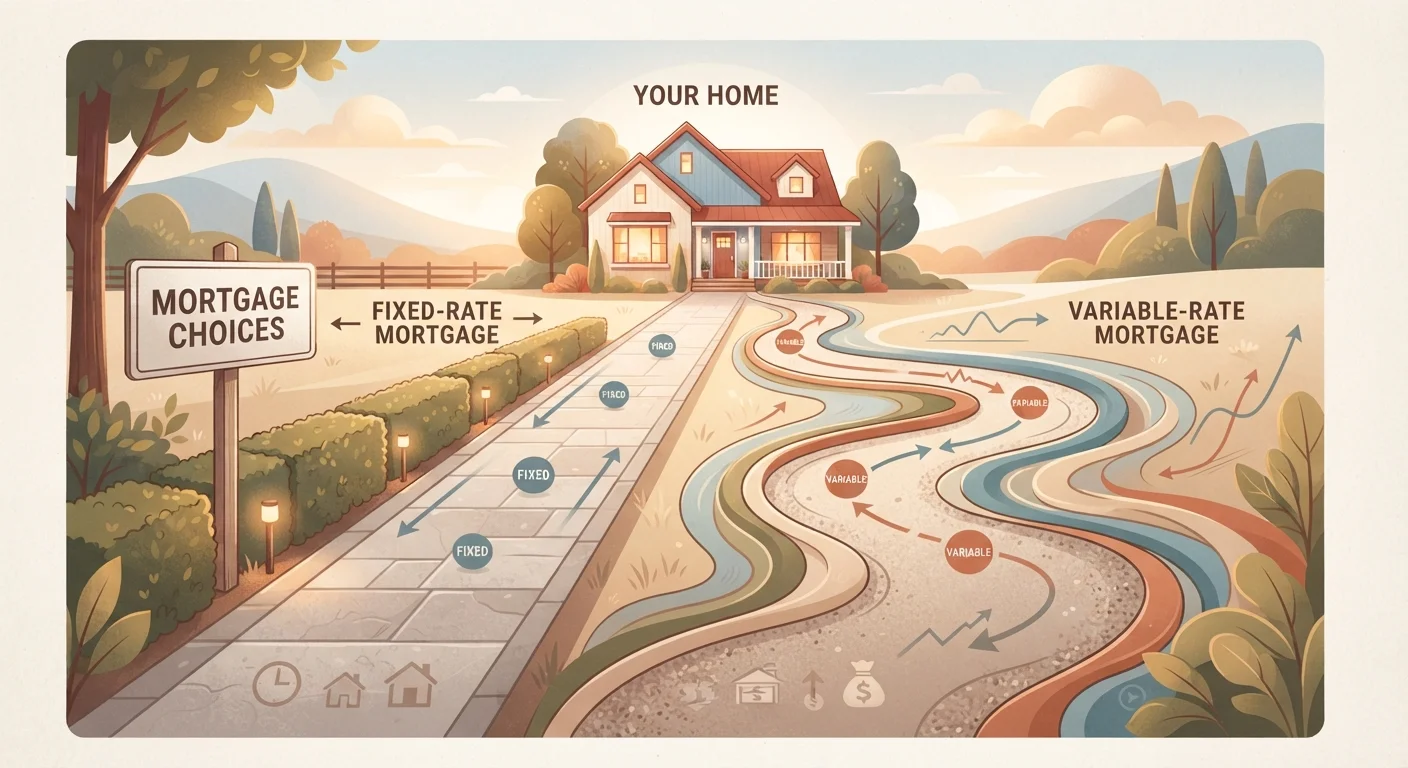
Photo credit: InfoHorizon.net | Access To Informative Content
In this article
A side-by-side look at how fixed and adjustable mortgage rates behave over time, and the situations where each tends to make sense.
Key Takeaways
- Fixed-rate mortgages lock in your interest rate for the entire loan term, ensuring payment stability.
- ARMs offer a lower introductory rate that resets periodically based on a market index after an initial fixed period.
- Fixed-rate loans carry less risk but typically start with a higher rate than comparable ARMs.
- ARMs can save money short-term but expose borrowers to payment increases if rates rise.
- Your expected length of homeownership is often the most important factor in choosing between the two.
- Understanding rate caps on ARMs is essential before committing to one.
How Each Mortgage Structure Works
A fixed-rate mortgage charges the same interest rate for the entire life of the loan — typically 15 or 30 years. Your principal and interest payment never changes, regardless of what happens in financial markets. This makes budgeting straightforward and eliminates interest-rate risk for the borrower.
An adjustable-rate mortgage (ARM) starts with a fixed introductory rate for a set period — commonly 5, 7, or 10 years — then adjusts periodically based on a benchmark index such as the Secured Overnight Financing Rate (SOFR). A 7/1 ARM, for example, holds its rate steady for seven years, then recalculates annually. The new rate equals the index plus a lender-set margin.
To understand why rates themselves move in the first place, see our explainer on how mortgage interest rates work. Rate movement ripples well beyond your monthly payment — the broader housing market impact is worth understanding before you commit.
| Criterion | Fixed-Rate Mortgage | Adjustable-Rate Mortgage (ARM) |
|---|---|---|
| Interest Rate Over Time | Stays the same for entire loan term | Fixed initially, then adjusts periodically |
| Typical Initial Rate | Higher than ARM introductory rate | Lower than equivalent fixed rate |
| Payment Predictability | Completely predictable | Predictable during fixed period only |
| Interest-Rate Risk | None — lender absorbs rate increases | Borrower absorbs rate increases after reset |
| Best Loan Term | 15 or 30 years | 5/1, 7/1, or 10/1 ARM structures |
| Ideal Ownership Horizon | Long-term (10+ years) | Short-to-medium term (under 7–10 years) |
| Refinancing Need | Only if rates drop significantly | Often prudent before adjustment period begins |
The Real Cost Difference Over Time
The lower initial rate on an ARM creates genuine savings in the early years. On a $400,000 loan, a 30-year fixed at 7% produces a monthly principal-and-interest payment of roughly $2,661. A 5/1 ARM opening at 5.5% would start around $2,271 — a monthly difference of about $390, or nearly $4,700 over the first year.
The calculus flips after adjustments begin. If the ARM resets upward by 2 percentage points annually (subject to caps), payments can escalate sharply. Most ARMs carry a periodic cap limiting how much the rate can change per adjustment and a lifetime cap capping total movement — often 5 percentage points above the start rate. Even so, a 5.5% ARM could legally reach 10.5% over its life, pushing the same $400,000 loan's payment above $3,600.
~30%
ARM share of mortgage applications during high-rate periods
According to the Mortgage Bankers Association, ARM applications tend to rise significantly when fixed rates climb above 6–7%, as buyers seek lower initial payments.
13 years
Average American homeownership duration
The National Association of Realtors has reported median tenure in a home of roughly 13 years, which often exceeds many ARM fixed periods.
5 pts
Typical ARM lifetime rate cap
Most conventional ARMs include a lifetime cap of 5 percentage points above the initial rate, limiting but not eliminating long-term payment risk.
Buyers weighing these numbers should also consider how the decision connects to the broader rent-versus-own question. Our look at renting vs. buying trade-offs provides helpful context on total cost of ownership.
Key Factors That Should Drive Your Decision
Several variables consistently determine which structure fits a borrower's situation:
- Time horizon: How long you intend to own the property is the single biggest factor. If your ownership window is shorter than the ARM's fixed period, you avoid adjustment risk entirely.
- Risk tolerance: Fixed-rate loans eliminate interest-rate risk. ARMs require comfort with future uncertainty — a scenario some buyers underestimate during the initial low-rate period.
- Current rate environment: When fixed rates are near historical lows, locking in makes obvious sense. When fixed rates are elevated, the gap between fixed and ARM introductory rates may be smaller, reducing the ARM's advantage.
- Income trajectory: Borrowers expecting meaningful income growth may be better positioned to absorb potential ARM payment increases than those on fixed incomes.
Understanding ARM Rate Caps Before You Sign
Every ARM comes with a cap structure that limits how much your rate can move. The most common format is 2/2/5 — meaning the rate can rise no more than 2% at the first adjustment, 2% at each subsequent adjustment, and 5% total over the loan's life. Always ask your lender to show you worst-case payment scenarios using the lifetime cap, not just the starting rate. This gives you a clearer picture of the financial range you may need to manage.
If stability matters to you the way a long lease term provides predictability in renting, you can see the same logic explored in our comparison of month-to-month vs. fixed-term leases.
This article is for general informational and educational purposes only and does not constitute personalized financial or mortgage advice. Consult a licensed mortgage professional or financial adviser before making borrowing decisions.

Author
Real Estate Editorial Team
Real Estate Editorial Team is the collective byline for our editorial team and contributor network. Articles published under this byline or an editorial pen name are researched, written, and reviewed according to our editorial standards for clarity, consistency, and independence before publication.
View all articles →