
What Every Car Sticker Price Actually Includes
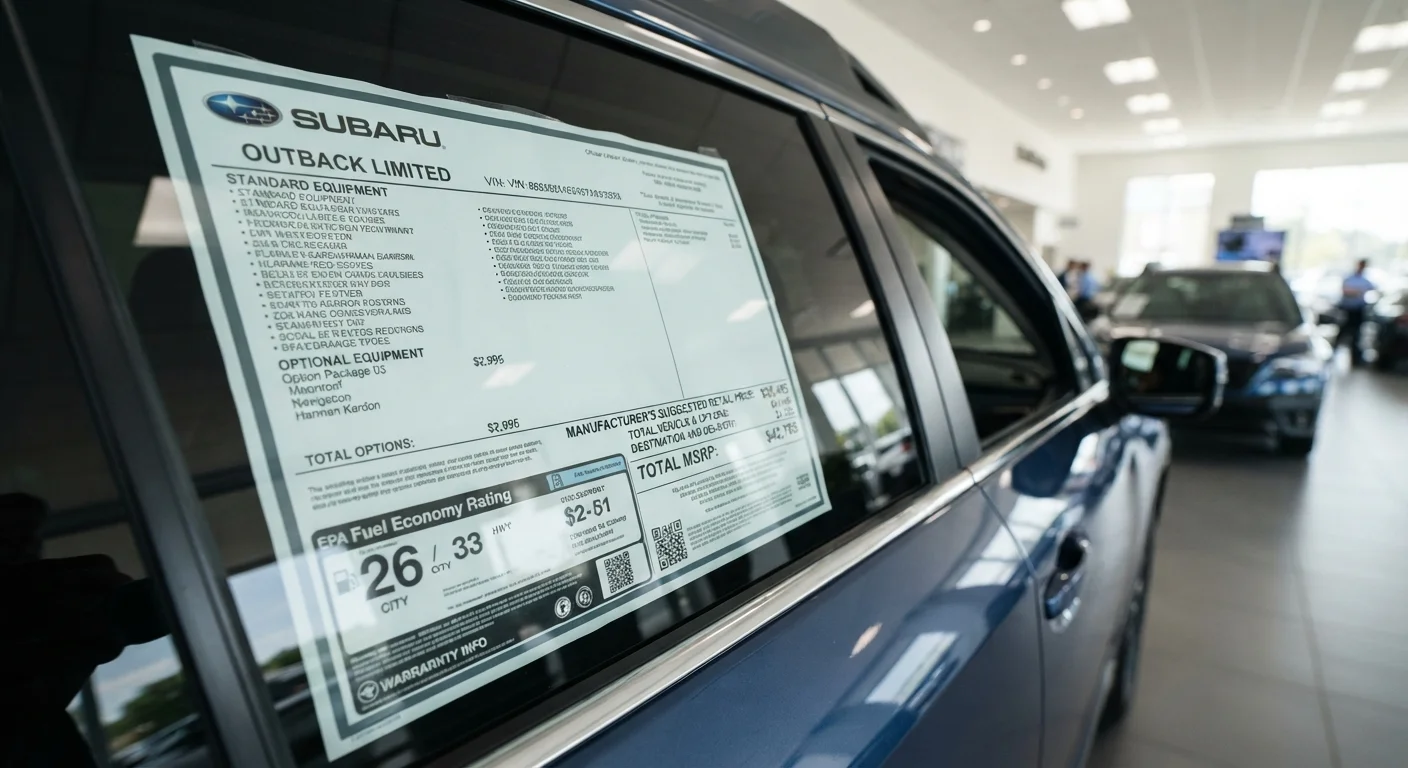
Photo credit: InfoHorizon.net | Access To Informative Content
In this article
The Monroney label on a car window tells you a lot—if you know how to read it. Here's what each line means.
Key Takeaways
- The MSRP is the manufacturer's suggested price - dealers can charge more or less depending on market conditions.
- Destination and delivery charges are non-negotiable fees set by the manufacturer, not the dealer.
- Options and packages listed on the sticker are added to the base price and can significantly raise the total.
- Fuel economy figures come from EPA testing and are standardized for comparison across vehicles.
- The sticker price is not the final price - taxes, registration, and dealer fees are added at signing.
What the Monroney Label Is - and Why It Exists
Walk onto any new-car lot and every vehicle in the showroom has a window sticker. That sticker is called a Monroney label, and federal law requires it to be there. Its purpose is straightforward: give buyers standardized, manufacturer-supplied information so they can compare vehicles on equal footing before a salesperson enters the conversation.
Think of it as the car equivalent of a standardized disclosure form. Just as a nutrition label lets you compare two breakfast cereals side by side, the Monroney label lets you compare two vehicles on objective terms - unlike, say, a salesperson's verbal description. The label covers six main areas: base price, installed options, destination charge, fuel economy, safety ratings, and a total MSRP.
Supplemental Stickers Are Not the Monroney
Dealerships sometimes place a second sticker alongside the official Monroney label listing dealer-installed accessories or market adjustments. These are not federally standardized and are set entirely at the dealer's discretion. Always identify which sticker is the manufacturer-issued Monroney before comparing figures across dealerships.
Breaking Down Each Line on the Sticker
Base Price (MSRP): This is the cost of the vehicle in its most basic trim configuration - standard engine, standard features, no extras. It is the floor, not the ceiling.
Factory-Installed Options and Packages: Every box that was checked at the factory is itemized here with its individual price. A technology package, a panoramic sunroof, or upgraded audio will each appear as a separate line. These are added to the base price to form the subtotal.
Destination and Delivery Charge: A flat fee the manufacturer charges to transport the vehicle from the assembly plant to the dealership. This figure does not vary by dealer location - a car shipped to a dealer in Nebraska carries the same destination charge as one shipped to Florida.
Total MSRP: The sum of base price, all options, and the destination charge. This is what the sticker calls the "total suggested retail price." It is the number most people refer to when they say "sticker price."
Fuel Economy Ratings: EPA city, highway, and combined mpg estimates appear in a standardized format. These numbers are produced under controlled laboratory conditions and serve as a comparison benchmark - real-world results vary based on driving habits and conditions.
Safety and Emissions Information: Some stickers include five-star safety rating summaries or emissions scores depending on vehicle type and model year. These are pulled from federal testing programs.
1958
Year Monroney disclosure became federal law
The Automobile Information Disclosure Act of 1958 established the requirement for window stickers on new vehicles sold in the U.S.
$1,000-$1,800
Typical destination charge range for passenger vehicles
Destination charges for most new cars and trucks in the U.S. generally fall within this range, depending on vehicle size and origin point.
6 sections
Key information areas on a standard Monroney label
A complete Monroney label covers base price, options, destination charge, fuel economy, safety ratings, and total MSRP.
What the Sticker Does Not Show
The Monroney label is informative, but it is not a complete picture of what you will pay. Several significant costs are absent:
- Sales tax: Varies by state and sometimes by county or city.
- Title and registration fees: State-determined fees to put the vehicle in your name.
- Dealer documentation fee: A processing fee dealers charge for paperwork. Amounts vary widely by dealer and state.
- Dealer-installed accessories: These appear on a separate supplemental sticker, not the Monroney. Floor mats, paint sealants, and window tinting added by the dealer fall into this category - and unlike factory options, they are negotiable.
Understanding the sticker as a starting point rather than a final number is the foundation of a pressure-free purchase. For a closer look at what gets added later, see our guide on add-ons dealerships offer at signing.
Photograph the Sticker Before You Negotiate
Before sitting down with a salesperson, take a clear photo of the full Monroney label. This gives you an exact record of every line item - base price, options, and destination charge - so you can reference accurate figures during the conversation. It also helps you verify that the vehicle you drove matches the one being quoted.
Using the Sticker Price as a Negotiation Baseline
Because the MSRP is set by the manufacturer and publicly available, it gives you a consistent reference point across every dealer carrying the same vehicle. Knowing whether a dealer is pricing above or below MSRP - and by how much - is essential context before any price discussion begins.
If you are also evaluating a used vehicle, keep in mind that used cars do not have a Monroney label. Understanding what a new-car sticker includes makes it easier to compare true value across both options. Our article on new car vs. used car differences beyond price walks through those distinctions in detail.
A vehicle history report is equally important when evaluating a used alternative - see reading a vehicle history report for guidance on interpreting that data.
The sticker is not a take-it-or-leave-it price. It is a documented, manufacturer-published baseline - and knowing exactly what each line represents puts you in the strongest possible position to evaluate what you are actually paying for.
Frequently Asked Questions

Author
Cars Editorial Team
Cars Editorial Team is the collective byline for our editorial team and contributor network. Articles published under this byline or an editorial pen name are researched, written, and reviewed according to our editorial standards for clarity, consistency, and independence before publication.
View all articles →