
Index Funds vs. Actively Managed Funds: What the Evidence Actually Shows
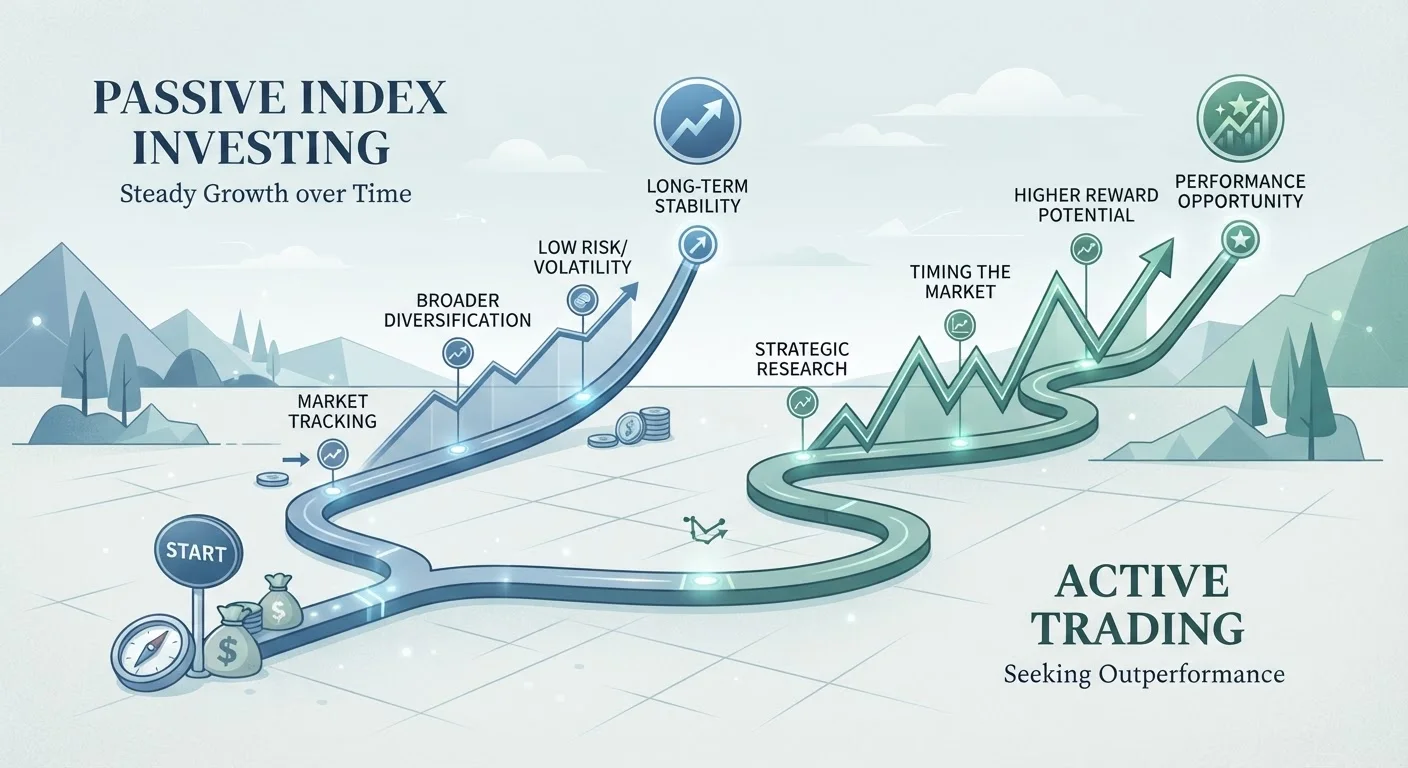
Photo credit: InfoHorizon.net | Access To Informative Content
In this article
Passive and active investing take very different approaches. Learn how each works, what costs look like, and what research says about long-run outcomes.
Key Takeaways
- Index funds track a market benchmark passively; actively managed funds rely on professional stock-picking decisions.
- Cost differences are significant — index funds typically charge a fraction of what active funds do.
- Long-term data consistently shows most actively managed funds underperform their benchmark index after fees.
- Neither approach eliminates investment risk; both can lose value when markets decline.
- Your time horizon, cost sensitivity, and financial goals should guide the choice between them.
How Each Approach Works
Before comparing outcomes, it helps to understand the mechanics. Before diving in, it's worth building some foundation — see what distinguishes saving from investing if you're starting from scratch.
An index fund is designed to replicate the performance of a specific market index — such as the S&P 500, which tracks 500 large U.S. companies. The fund buys the same securities as the index, in roughly the same proportions, and holds them. There's no team of analysts deciding what to buy or sell. The goal is simply to match what the market does, not beat it.
An actively managed fund works differently. A professional portfolio manager — supported by a research team — selects securities based on analysis, forecasts, and judgment. The goal is to outperform a benchmark index by identifying undervalued stocks, timing market moves, or rotating into sectors expected to rise. This requires ongoing research and decision-making.
Understanding how these funds fit into a broader portfolio is easier when you know the basics — stocks, bonds, and cash each play different roles in an investment mix, and both fund types can hold any combination of them.
The Cost Gap Is Larger Than It Looks
Fees are one of the most concrete differences between these two fund types, and their compounding effect over time is often underestimated.
| Criterion | Index Funds | Actively Managed Funds |
|---|---|---|
| Management style | Passive — tracks an index | Active — manager selects holdings |
| Typical expense ratio | 0.03%–0.20% annually | 0.50%–1.00%+ annually |
| Goal | Match market performance | Beat a benchmark index |
| Trading frequency | Low — mirrors index changes | Higher — based on manager decisions |
| Tax efficiency | Generally higher | Generally lower |
| Long-run benchmark outperformance | Matches market by design | Majority underperform after fees |
Index funds typically charge an expense ratio — the annual fee as a percentage of assets — that can be as low as 0.03% to 0.20%. Many actively managed funds charge between 0.50% and 1.00% or more annually. That gap may sound small, but over 20 or 30 years of investing, it translates to a meaningful difference in net returns. A 1% annual fee difference on a $50,000 investment compounding over 30 years can reduce total accumulated value by tens of thousands of dollars — a rough illustration, not a guarantee.
Active funds may also generate more taxable events through frequent trading, which can reduce after-tax returns in taxable accounts. Index funds, with low turnover, tend to be more tax-efficient by comparison.
~85%
Active large-cap funds underperforming over 15 years
SPIVA U.S. Scorecard data has repeatedly shown roughly 80–90% of actively managed U.S. large-cap funds underperform the S&P 500 over 15-year periods, after fees.
0.03%
Lowest common index fund expense ratios
Some broad market index funds available in the U.S. carry annual expense ratios as low as 0.03%, a historically low cost driven by competition in passive investing.
What Research Shows About Long-Run Performance
The performance question is where evidence becomes most instructive. The S&P Dow Jones Indices SPIVA (S&P Indices Versus Active) reports, published regularly, track how actively managed funds perform relative to their benchmark indexes. Across multiple time periods and fund categories, the data consistently shows that the majority of active funds underperform their benchmarks over 10- and 15-year periods, after fees.
This doesn't mean every active fund fails — some managers do outperform for stretches. But identifying in advance which managers will outperform is extremely difficult, and past outperformance is not a reliable predictor of future results. Research also suggests that even when active funds beat the market in one period, they frequently fail to repeat that performance.
Market Efficiency Varies by Segment
The case for active management is generally stronger in less liquid or less analyzed market segments — such as small-cap international stocks or emerging markets — where public information is less uniformly priced in. In highly liquid, heavily analyzed markets like U.S. large-cap equities, consistent outperformance is considerably harder to achieve. This doesn't guarantee active management will succeed even in less efficient segments, but the theoretical opportunity is wider.
It's worth noting that market conditions matter. Some research suggests active management may have more opportunity to add value in less-efficient markets — such as small-cap international stocks — where information is less uniformly available. Broad U.S. large-cap markets, however, are highly efficient, making consistent outperformance particularly difficult. For more on how portfolio construction ties into these decisions, understanding diversification is a useful next step.
Making a Decision That Fits Your Situation
Neither fund type is universally right. Index funds offer predictability of cost and market-matching exposure, which suits many long-term investors. Actively managed funds represent a bet that a manager's skill will overcome both the market's efficiency and the drag of higher fees — a bet that data suggests is difficult to win consistently, though not impossible in every context.
Some investors use a blend: a core of low-cost index funds for broad market exposure, with a small allocation to active strategies in specific areas where they believe active management has more potential. This hybrid approach isn't a recommendation — it's one of several structures people consider based on their goals and risk tolerance.
If you're concerned that myths or misconceptions are shaping your thinking, common investing myths are worth examining before making any decisions. And for a parallel look at how evidence-based thinking applies to other major financial choices, renting vs. buying a home offers a similar framework.
As always, decisions about your own investments should involve a licensed financial professional who can assess your specific circumstances, goals, and tax situation.
This article is for general informational and educational purposes only and does not constitute personalized financial, investment, or tax advice. Past performance does not guarantee future results. All investing involves risk, including the possible loss of principal. Consult a qualified financial adviser before making investment decisions.

Author
Finance Editorial Team
Finance Editorial Team is the collective byline for our editorial team and contributor network. Articles published under this byline or an editorial pen name are researched, written, and reviewed according to our editorial standards for clarity, consistency, and independence before publication.
View all articles →