
Compound Interest: The Quiet Force Behind Long-Term Wealth
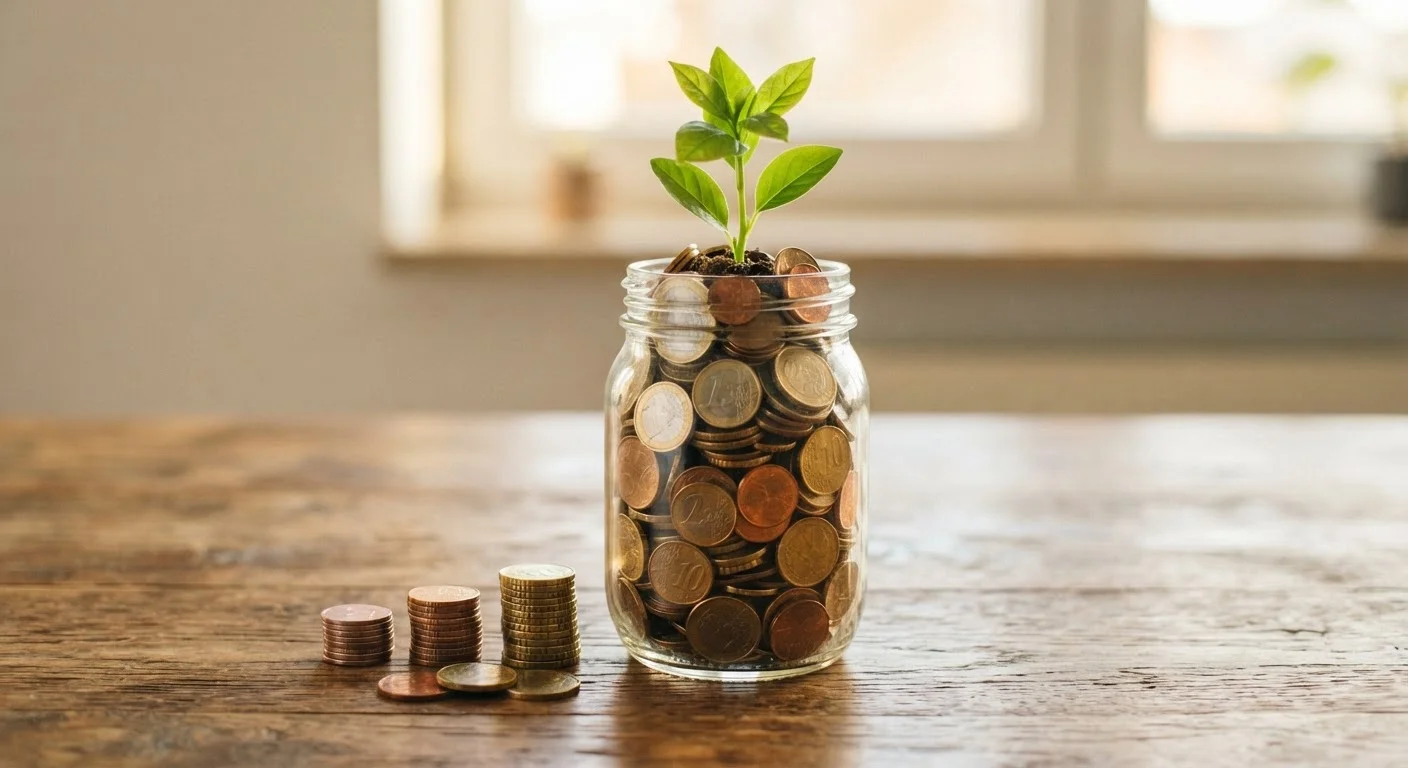
Photo credit: InfoHorizon.net | Access To Informative Content
In this article
Compound interest grows money faster than most people expect. Here's how it works, why it matters, and how time affects the math.
Key Takeaways
- Compound interest grows both your original balance and the interest already earned, creating accelerating growth.
- Time is the single most powerful variable — starting earlier has more impact than contributing larger amounts later.
- Compounding works against you when applied to debt, making high-interest balances expensive to carry.
- Even modest, consistent contributions can grow substantially over decades thanks to compounding.
- Inflation can offset compounding gains on low-yield savings, so the interest rate relative to inflation matters.
How Compound Interest Actually Works
The mechanics are simpler than most people expect. Suppose you deposit $1,000 into an account earning 5% interest per year. After year one, you earn $50 in interest, giving you $1,050. In year two, that 5% applies to $1,050 — not just the original $1,000 — so you earn $52.50. The following year, interest is calculated on $1,102.50. Each cycle, the base grows a little larger.
This self-reinforcing loop is what separates compound interest from simple interest. The growth isn't dramatic in year two or year three, but give it a decade or two and the acceleration becomes clearly visible. A $10,000 deposit at 6% annual compound interest becomes roughly $18,000 after 10 years without adding another dollar — and nearly $57,000 after 30 years.
~$57,000
Value of $10,000 after 30 years at 6% compound interest
Illustrative calculation assuming annual compounding with no additional contributions — demonstrates the long-run growth effect.
72 ÷ rate
Rule of 72: years to double money
A widely used mental math shortcut — divide 72 by the annual interest rate to estimate how many years it takes a balance to double.
10 years
Head start that can outweigh double the principal
Illustrative comparison showing that an earlier start at a lower amount often produces larger outcomes than a larger amount invested a decade later.
The compounding frequency — how often the interest is calculated and added to your balance — also plays a role. Daily compounding produces slightly more than annual compounding at the same stated rate, though the difference is modest on typical consumer accounts.
Why Time Is the Most Powerful Variable
The math of compounding rewards patience more than it rewards large lump sums. Consider two savers: one invests $5,000 at age 25 and never adds another dollar. The other waits until 35 and then invests $10,000. Assuming a consistent 7% annual return, the person who started earlier — with half the money — ends up with more at retirement age. Starting a decade earlier overcomes a $5,000 deficit.
This is often described as a counterintuitive result, but it follows directly from how compounding works. Every year of delay is a year that early growth cannot happen — and that lost early growth cannot easily be recovered later.
Use the Rule of 72 as a Quick Check
Divide 72 by the annual interest rate on any account to estimate how many years it takes your money to double. At 4%, that's roughly 18 years; at 8%, about 9 years. This simple calculation makes it easier to compare accounts or set realistic expectations without a spreadsheet.
It also means that pulling money out of a compounding account early has costs beyond what you withdraw. Removing funds resets the base, shrinking all future compounding cycles. This is one reason financial professionals often distinguish between funds meant for long-term growth and money needed in the near term. For more on the behavioral patterns that can quietly disrupt this kind of long-term accumulation, see habits that derail long-term savers.
When Compounding Works Against You
The same mechanism that builds wealth in savings and investments accelerates costs in debt. Credit cards, payday loans, and other high-interest products typically compound the unpaid balance — meaning interest accrues on top of interest already charged. A $3,000 credit card balance at 22% APR, paid only at the minimum, can take over a decade to clear and cost more than the original charges several times over.
This is not a warning against using credit — it is a description of how the math works. Understanding that compounding is bidirectional helps explain why reducing high-interest debt is often described as one of the highest-return financial actions available, since eliminating that interest rate removes compounding working in the wrong direction. For a broader look at what inflation does to idle savings, see how purchasing power erodes over time.
Inflation and Compounding Interact
Compound interest grows your nominal balance — the number you see on a statement. But inflation reduces purchasing power over time. If your savings account compounds at 2% and inflation runs at 3%, your real purchasing power is declining even though your balance is rising. This is why the interest rate relative to inflation matters when evaluating where to keep long-term savings.
Putting Compounding to Work Practically
You do not need large sums to benefit from compound interest. Regular, modest contributions added to a compounding base are often more effective than irregular large deposits. When contributions are made consistently — a strategy sometimes paired with dollar-cost averaging — the compounding base grows steadily rather than in sporadic jumps.
The key practical levers are: the interest rate or return rate, how frequently compounding occurs, the starting amount, how consistently you add to it, and how long you leave it undisturbed. Of these, the interest rate and time horizon tend to drive the largest differences in outcomes. A slightly higher rate sustained over a long period outperforms a high rate sustained briefly.
If compounding is a new concept, it is worth reviewing common investing myths that lead people to delay getting started — because with compounding, delay has a real, calculable cost. This article is for general educational purposes and does not constitute personalized financial advice. Consult a qualified financial professional before making decisions based on your specific circumstances.
Frequently Asked Questions

Author
Finance Editorial Team
Finance Editorial Team is the collective byline for our editorial team and contributor network. Articles published under this byline or an editorial pen name are researched, written, and reviewed according to our editorial standards for clarity, consistency, and independence before publication.
View all articles →